Webinaire SF2M
La perception spatio-temporelle des textures par les mécanorécepteurs cutanés
Les webinaires de la SF2M continuent en 2026 !
Depuis le mois de septembre 2024, les Webinaires SF2M balaient tous les matériaux (métaux, céramiques, polymères, multimatériaux et composites, …) et présentent des visions industrielles ainsi que des progrès scientifiques récents, tout en mettant en avant les matériaux, notre communauté … et la SF2M !!
Ce deuxième webinaire de 2026 aura pour thème « La perception spatio-temporelle des textures par les mécanorécepteurs cutanés ». Il sera présenté par Hassan ZAHOUANI. Il aura lieu le mardi 20 janvier de 13h à 14h.
Retrouvez la liste des webinaires
Résumé du webinaire
Pour les organismes vivants, détecter les forces mécaniques est d’une importance capitale pour interagir avec le monde physique. La mécano-transduction définie comme la transformation d’un stimulus mécanique en une réponse biologique, constitue la base de nombreuses fonctions physiologiques fondamentales dont le toucher, et contribue à l’intégrité et la survie des organismes. Chez l’homme, la mécano-sensation cutanée, ou sens du toucher, permet de détecter et de différencier de multiples stimuli mécaniques environnementaux : vibration, texture, pincements, étirements cutanés. Ce sont les neurones du système somato-sensoriel qui contrôlent cette modalité. Leurs corps cellulaires, situés dans les ganglions rachidiens dorsaux, envoient des prolongements vers la peau. Chaque terminaison nerveuse possède des récepteurs spécialisés sensibles aux forces mécaniques (mécanorécepteurs) qui transforment les différentes forces mécaniques en signal électrique spécifique pour générer des potentiels d’action chargés de propager l’information jusqu’au système nerveux central.
Ce sujet a connu ces dernières années un développement important au niveau national et international. Le but ultime est de mettre au point des approches scientifiques pour quantifier et comprendre les signatures pertinentes de l’interface peau humaine / texture, où pulpe du doigt sur peau humaine. Cette recherche se situe à l’interface des disciplines que sont la texturation des surfaces, les revêtements, la métrologie, la rhéologie des matériaux, la mécanique du contact, la tribologie, la vibro-acoustique et les neurosciences. Dans ce cadre, au sein du laboratoire de Tribologie et Dynamique des Systèmes, UMR CNRS 5513 (LTDS), nous avons développé depuis une vingtaine d’année des technologies haptiques instrumentées spécifiquement conçues pour modéliser et caractériser la perception tactile. Le dernier dispositif développé « TouchyFinger », basé sur l’équipement de la pulpe du doigt avec un capteur de force et un capteur de vibration. Le système est muni d’un analyseur du spectre de vibration et permet de quantifier l’intensité, la fréquence et la longueur d’onde dans les quatre mécanorécepteurs de la pulpe du doigt. Avec une analyse temps-fréquence, TouchyFinger permet de représenter l’intensité vibratoire et la fréquence fondamentale dans chaque bande de fréquences des mécanorécepteurs, figure (1). Ces informations issues de la mécano-transduction ont permis de quantifier l’effet des textures et la raideur des matériaux sur la sensibilité des mécanorécepteurs. Une étude sur l’effet du vieillissement sur l’acuité tactile des mécanorécepteurs, a permis de montrer la perte de sensation lors du vieillissement.
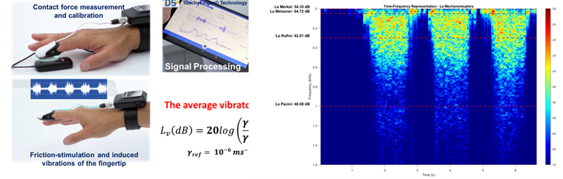
Figure (1). Le dispositif « TouchyFinger » et l’analyse de l’excitation des mécanorécepteurs de la pulpe du doigt.
|
Conférencier : Hassan ZAHOUANI, Laboratoire de Tribologie et Dynamique des Systèmes (LTDS), École Centrale de Lyon. Hassan Zahouani is a Professor at Ecole Nationale des Ingénieurs de Saint-Étienne, École Centrale de Lyon since 1991 (Exceptional Class 1 & 2). He is Associate Professor at the University of Halmstad (Sweeden) and President of the Francophone Society of Engineering and of Skin Imaging. In 2022 and 2023 he was ranked by the American University Stanford as one of the 160,000 most cited researchers in the world. In 2023 he was designated as a Fellow of the Carnot Institute in Lyon, for the expertise acquired worldwide in the mechanics and imaging of living tissues. In 2024, Pr H. Zahouani was named a Top Scholar by ScholarGPS. ScholarGPS recognizes Top Scholar for their outstanding performance in various field, Disciplines, and Specialties. The strong publication record of Professor H. Zahouani, the impact of his work and the notable quality of his scholarly contributions placed Professor Hassan Zahouani in the top of 0.5% of all scholars worldwide. HONORS – Associate Professor at Halmstad University – President of the French Society of Engineering and skin imaging (created since 1999) – Ranking by the American University Stanford as one of the 160,000 most cited researchers in the world (2022 and 2023). – Professor H. Zahouani is named TopScholar GPS, 2024 – Designation as a Fellow of the Carnot Institute in Lyon, for the expertise acquired worldwide in the mechanobiology and imaging of living tissues (2023). – Founding Member of the International Journal Surface Topography – Member of the editorial board of the journal surface topography – Member of the steering committee of the Metrology and Properties of Engineering Surfaces Conference – Chairman of six international conferences – Best Paper Award. “H. Zahouani & al, Effect of roughness on vibration of human finger during a friction test”. 19th International Conference on WEAR OF MATERIALS. Portland, Oregon, USA. April 14-18, 2013 – Prize for the best paper awarded by the International Society of Bioengineering and Imaging of skin: “H. Zahouani & al, Maturation of skin tension in newborns: Characterization and modeling”. San Diego. June 2018, – Innovation award for the TouchyFinger© device by the international jury of Cosmetic Valley, 2021 |
|

organisateur
SF2M
date
20 janvier 2026
Lieu
Webinaire
Contact
secretariat@sf2m.fr